
倒数第二次恋爱
Grassroots official’s 30-year fight against desertification in North China_我的网站

一 | A South Korean company has begun production at a huge new solar panel factory in Georgia even as industry leaders say surging Asian imports could dampen efforts to make more solar components in the United States.Qcells, a unit of South Korea’s Hanwha Group, said Wednesday that it can now turn out enough solar panels to generate 5.1 gigawatts of power yearly at a two-factory complex in the northwest Georgia city of Dalton. That's almost 40% of U.S. solar panel capacity, according to figures from the Solar Energy Industries Association. Qcells' opened its first factory in 2019 and an even larger plant in phases since, what the company describes as the largest solar investment in American history. “It’s another milestone as we as a company really strive to become a global leader and a U.S. leader in solar manufacturing," said Scott Moskowitz, Qcells head of market strategy and public affairs, speaking with The Associated Press after a plant tour Monday.The company says its new plant is the first solar module factory in the U.S. to begin production since passage of President Joe Biden’s signature climate legislation. Qcells' $208 million investment again shows how federal incentives are spurring a nationwide boom in renewable energy and electric vehicles.Industry jitters about a flood of cheap solar panels from overseas show how dependent on federal policy the solar industry remains. That's a threat in part because former President Donald Trump, the frontrunner for the 2024 Republican nomination, is hostile to renewable energy.Qcells leaders say the new plant showcases more efficient equipment and processes, part of a much larger investment intended to bring key steps in solar manufacturing to the U.S. A solar panel, or module, is assembled from solar cells most commonly made from wafers cut from ingots of polysilicon. Today, the company's solar cells are imported from Asia. But 30 miles (50 kilometers) south of Dalton in Cartersville, Qcells is building a $2.3 billion complex to take polysilicon refined in Washington state and make ingots, wafers and solar cells — in addition to 3.3 gigawatts of solar modules. That plant is scheduled to open in phases starting next year.Currently, no silicon ingots or wafers are made in the U.S. But Biden's Inflation Reduction Act, besides offering a extra tax credit on American-made solar equipment, lets manufacturers earn incentives for every unit of polysilicon they refine and every wafer, cell and module they make. For example, Qcells earns a tax credit of 7 cents per watt for every panel it makes in Dalton, or $34.30 for every 490-watt residential panel made.Even with that boost, solar industry leaders warn, factories will struggle to compete with a new spike in cheap Asian imports. They're again urging federal officials to investigate whether solar panels are being dumped at unfairly low prices. Previous investigations have led to anti-dumping tariffs on panels made in China and Taiwan.U.S. officials shouldn't regard the spike as a normal market fluctuation, said Mike Carr, executive director of the Solar Energy Manufacturers for America Coalition, a group that includes Qcells. He argues Chinese component makers are pushing out cheap modules from southeast Asian factories, tanking panel prices to ensure Chinese dominance and smother U.S. manufacturing.“This is likely to be the No. 1 new energy source in the 21st century," Carr said. "It’s already cheaper than pretty much anything else to install. It is the path to meeting our climate goals. So I think it becomes a real national security kind of concern. The way OPEC is in oil markets, we don’t want to allow China to become that same controller of supply in solar.”Qcells sees current low prices as a “near-term challenge" in achieving economies of scale and serving a long-term market, Moskowitz said. Beyond trade policy, he said, requiring federal agencies to buy American-made products and promoting panels produced with fewer carbon emissions could bolster Qcells.Politics envelops the solar industry. Vice President Kamala Harris visited the plant earlier this year. At the state level, Republican Gov. Brian Kemp has wrestled with Democratic U.S. Sen. Jon Ossoff over political credit for electric vehicle and renewable energy investments flowing to Georgia. “Out of all the places Qcells could have gone, they chose to operate and expand here in Georgia because of our unrivaled assets and the competitive package we put together,” Kemp said in a statement.Ossoff and fellow Georgia Democratic Sen. Raphael Warnock note they authored the component incentives that benefit Qcells, emphasizing federal policy. “Our state is emerging as the advanced energy capital of the nation, thanks to federal infrastructure and manufacturing policies that are benefiting Georgia more than any other state,” Ossoff said in a statement.Qcells, for its part, praises both state and federal assistance.“To build these markets up and to have them work, you need a whole government approach," Moskowitz said.。
Ecological restoration
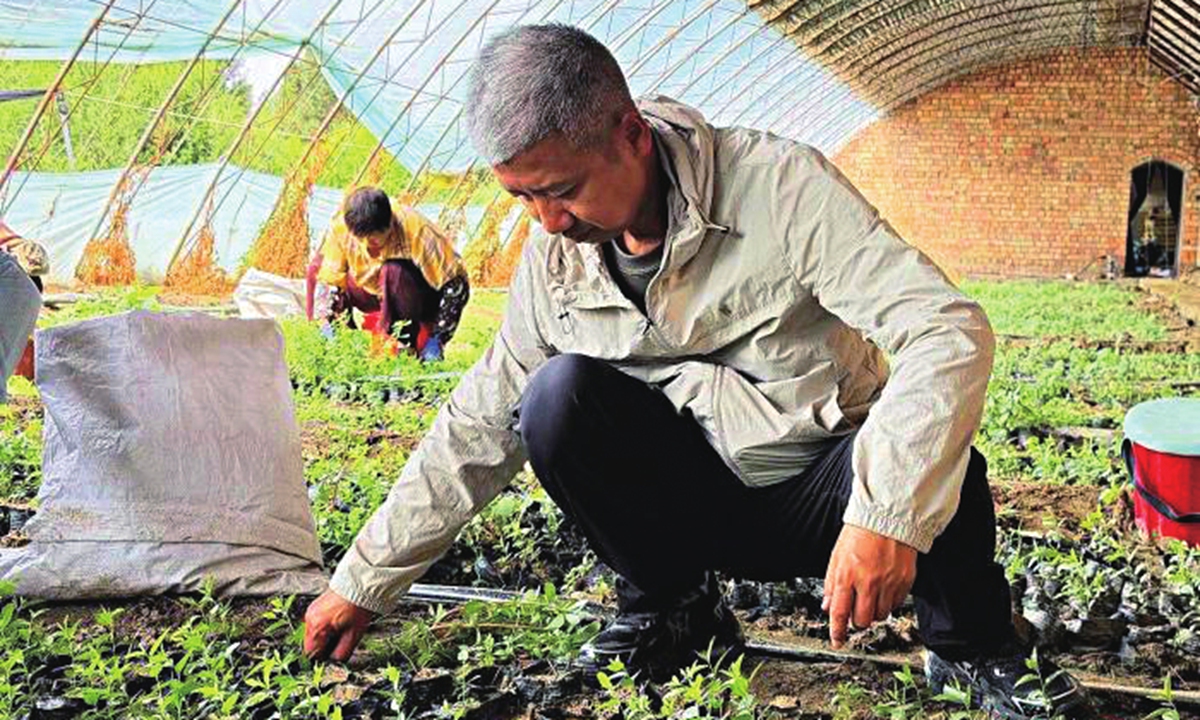
For over 30 years, Wensuyalatu, a member of the leadership group of the Urad Rear Banner forestry and grassland bureau, has made the Gobi Desert his workplace, dedicating his life to combating desertification, advancing ecological restoration through technological innovation, and helping local herders increase their incomes, according to the local bureau's official WeChat account.
Located on the edge of the desert in Bayannur's Urad Rear Banner, it is a key area in China's Three-North Shelterbelt Forest Program, a major ecological project aimed at strengthening the country's northern ecological security barrier.
However, early afforestation efforts in the desert were far from easy at the start.
The project covers 103,800 mu (about 6,920 hectares), including comprehensive treatment of 24,500 mu of desertified land, ecological restoration of 4,100 mu of non-desertified land, and 75,200 mu of enclosed grassland restoration. The project also includes the construction of 11 small-scale water conservation facilities, all of which required strict standards and extensive coordination.
The project also includes the construction of 11 small-scale water conservation facilities, all of which required strict standards and extensive coordination.
In 1991, Wensuyalatu, then in his early 20s, chose to devote himself to forestry and grassland conservation in the Urad Rear Banner. Since then, he has remained on the front lines of desertification control, witnessing the region's harshest environmental challenges and working to find solutions adapted to the fragile desert ecosystem.
In the early years, afforestation in the Gobi Desert was an extremely difficult task. The most critical planting season in spring often coincided with the strongest sandstorms of the year. Every year during the key afforestation period, Wensuyalatu would stay deep in the desert, guiding workers on planting techniques and management practices, while carefully overseeing every detail of the ecological restoration projects.
"Every spring, the wind and blown sand were so strong that it was hard to keep your eyes open. The sand hit your face like needles. During the day, we followed workers to dig holes and plant trees, and at night we stayed in temporary shelters to organize data and review the day's work. That was the normal routine for desertification fighters," Wensuyalatu recalled.
The road to restoring the desert was far from easy. Years of drought, low survival rates of seedlings, and skepticism from some local residents created major obstacles.
"At the beginning, it was really difficult. The climate was extremely dry, and many seedlings died after being planted. Some herders did not understand or support the work. They believed deserts were naturally barren and that no amount of effort could make trees grow there," Wensuyalatu said.
To change these perceptions, Wensuyalatu brought local residents to see firsthand the damage caused by desert expansion. Through visible results and long-term communication, he gradually won the understanding and support of the community.
Facing the ecological challenges of the Urad Rear Banner, Wensuyalatu began exploring new approaches beyond traditional restoration methods.

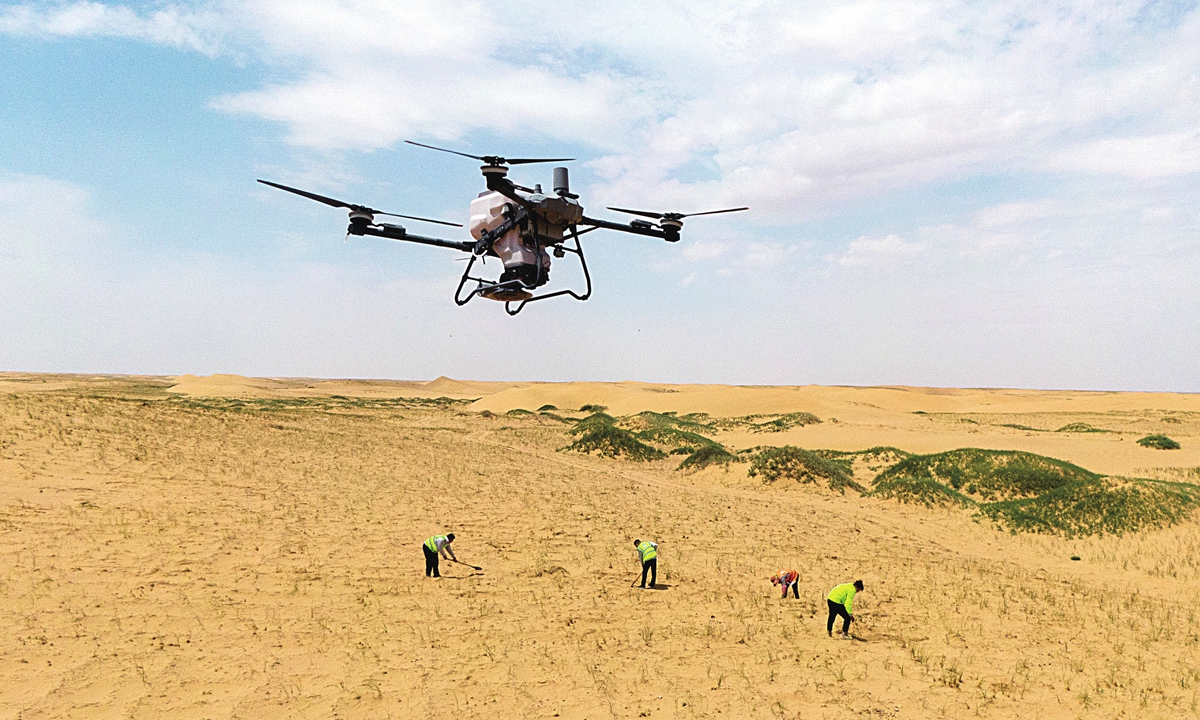
Since 2004, he has led efforts to tackle desert restoration challenges by introducing large-scale aerial seeding projects, creating a breakthrough approach for restoring degraded desert ecosystems in the region.
"Compared with traditional methods, aerial seeding is more efficient and can cover wider areas. Based on local climate and soil conditions, we select suitable desert plant seeds and precisely control the seeding height, density and timing to improve survival rates as much as possible and accelerate desert recovery," Wensuyalatu explained.
After years of effort, the aerial seeding projects under Wensuyalatu's leadership have restored more than 800,000 mu of desert land, with an effective restoration rate of 62.2 percent.
He also developed an integrated management approach combining "protection, management, retreat, restoration and publicity," establishing a mixed vegetation system of trees, shrubs and grass to curb desert expansion and reduce sandstorms at their source.
Beyond restoring greenery, Wensuyalatu has also focused on strengthening scientific research and protecting native desert species.
Starting in 2010, he devoted himself to the artificial cultivation of endangered native desert plants. After more than a decade of repeated experiments, he successfully developed cultivation techniques for rare species such as the endangered evergreen broadleaf shrub Ammopiptanthus mongolicus, Mongolian almond and drought-resistant elm.
Under his leadership, his team cultivated 6.5 million seedlings and completed more than 4,000 mu of high-quality afforestation projects, with seedling survival rates consistently exceeding 80 percent.
For Wensuyalatu, desert restoration is not only about creating ecological benefits, but also about improving people's livelihoods.
He has long promoted the idea that "trees should bring both ecological value and economic value." By leveraging local desert resources, he helped establish a 10,000-mu industrial base for desert plants and cistanche - a medicinal plant often grown in desert environments - across four key local villages, integrating ecological restoration with specialty desert industries.
"In the past, people thought desertification control was simply about planting trees - it took a lot of efforts but brought little income. Now things are different. By planting trees and developing industries such as cistanche cultivation, desert land can generate real wealth," a local herder said.
To ensure that local communities benefit from ecological development, Wensuyalatu introduced enterprises, supported family forest farms and professional cooperatives, and promoted large-scale, market-oriented operations.
The once barren desert has gradually become a "green treasure chest" for local herders, achieving a win-win outcome: greener landscapes, improved ecosystems, stronger businesses and higher incomes.
"Desertification control is not just an ecological project, but also a project that benefits people," Wensuyalatu said.
"Only when communities gain real benefits from protecting nature will they actively participate in ecological conservation. That is the key to making restoration efforts sustainable and achieving the vision that lucid waters and lush mountains are invaluable assets," Wensuyalatu said.
Global Times
。
Current article:http://4evvo.shangfochengcongshuaizhuang.buzz/pwp7/fccvj2.html
Published on:03:17:29
- Danish deputy PM leaves politics, but party stays on in the center-right government
- 四川隆昌养猪场污水直排农田造成污染?官方通报
- 午后直线拉升!A股两大板块涨停潮!微小盘股表现强劲
- 京东第二杀戮日:只有一天,一年新低
- コーヒーはいつ飲むべき? エネルギー補給にベストなタイミングを栄養士が解説
- 国产AI算力迎来“芯”质检官 百亿级芯片测试基地在富阳封顶
- 大力优化营商环境 加快高质量发展|零工市场+零工超市,破解用工就业“两头难”
- 上传目录变后门温床:三招封死WebShell上传
- 百万桶石油“集体失联”?阿拉伯湾八成油轮隐身暗渡海峡运石油
- 【收评】纯碱日内下跌1.05%机构称纯碱基本面宽松不改,期价底部震荡
- 菲律宾智库专家:中菲关系紧张升级,背后主要有三大原因
- 陪跑8年拟退出,北汽系基金要与淄博这家企业分道扬镳?
- “沙德尔” 影响,明后天风雨登场
- 《上海市加快推进新型工业化构建现代化产业体系“十五五”规划》:推进高性能算力芯片、通用处理器芯片、存储芯片、互联芯片和智能传感器达到国际先进水平
- 脆弱稳定期,耐心等风停
- 八大局·八个场景·八种品质
- 尹锡悦被逮捕的细节及画面曝光 行动使用 “攻城兵器”历时七个小时
- 中信银行:上半年净利润376.02亿元,同比增长3.08%
- Rishab Shetty Breaks Silence on Ranveer Singh’s Daiva Mimicry Controversy After IFFI
- PGCIL Recruitment 2025: आवेदन आज से स्टार्ट, कुल 1543 पदों पर निकली भर्ती